Deciding whether to use in-house accounting or outsourcing is one of the most consequential decisions a business can make. Your accounting functions affect financial visibility, compliance, cash flow management, and the information leaders use to make decisions.
The right approach involves considering your business size, accounting needs, budget, growth plans, and available internal resources.
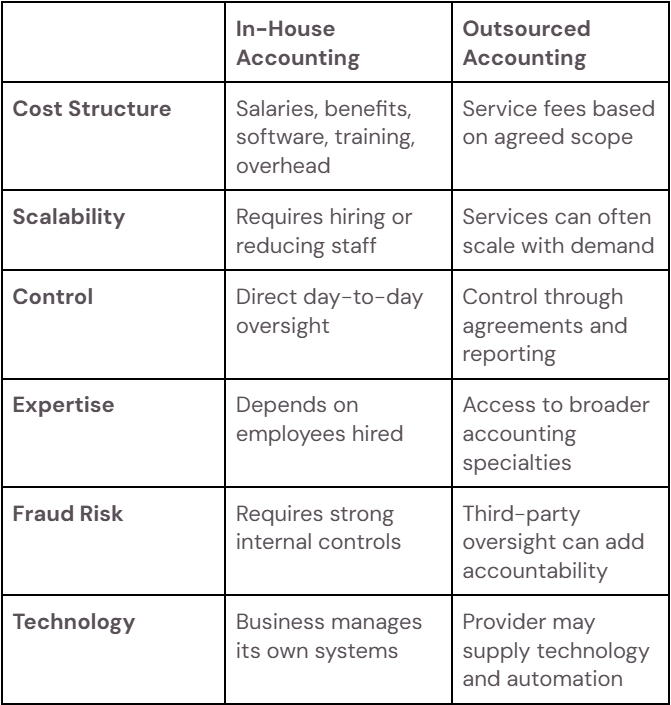
In-house accounting relies on employees within your business, while outsourced accounting assigns some or all functions to an external provider. Both options can support accurate financial reporting and effective financial management, but they differ in how businesses manage costs, oversee processes, and scale accounting operations.
In-house teams offer direct, day-to-day control over processes and workflows, while outsourced accountants operate under service agreements with defined deliverables and reporting structures. This can include regular meetings, reporting procedures, deadlines, and communication channels that establish efficiency without requiring an on-site presence.
In-house accounting requires time to recruit, train, and retain accounting professionals, while outsourcing affords access to a broader pool of accounting expertise. When you need dedicated employees with detailed knowledge of your operations, hiring in-house can make sense. However, finding the right specialized professional can take time and resources.
A firm, meanwhile, gives you access to specialists across several areas without the cost of hiring each one.
As business needs shift, you may have to keep hiring or cutting internal staff. Outsourced accounting helps with scaling up and down, adjusting for growth, seasonal activity, acquisitions, new locations, or changes in reporting requirements.
Outsourced accounting firms often provide established technology and automation capabilities, while in-house teams typically rely on established, widely available accounting software that may not offer as many customizations. Adopting new systems requires investments and ongoing management that an in-house team may not have the bandwidth to oversee. An experienced accounting team likely already has the technology infrastructure and processes designed around essential functions.
In-house accounting offers many benefits, including direct oversight, close integration with your business, and dedicated employees who understand the operations. Internal accounting can be especially valuable when accounting activities closely connect to daily operations or require regular collaboration with other departments.
In-house accountants embed themselves in the organization, centralizing communication, collaboration, and access to financial details. Accountants can quickly connect with sales, operations, or human resources, developing detailed knowledge of processes and financial history.
Direct oversight of the accounting team provides greater visibility into processes, responsibilities, and output. This oversight also allows business leaders to establish internal procedures, review work directly, and make changes without coordinating with an outside provider. Internal teams can also develop processes directly tailored to organizational needs.
Internal accounting employees can contribute more than bookkeeping and financial reporting, depending on their skills and responsibilities. Common additional responsibilities can include:
For all its advantages, in-house accounting can also come with its own drawbacks. These can include higher overhead costs, hiring and retention challenges, limited specialization, and greater responsibility for managing accounting systems and controls.
Maintaining an internal accounting department costs more than employee salaries alone; hiring managers must also consider expenses such as benefits, software, training, workspace, recruiting, and turnover. Replacing an employee also creates additional recruiting, onboarding, and training costs on top of lost productivity. Lastly, maintaining and investing in accounting software and other technology is an ongoing expense.
If you need only a limited amount of accounting support, these expenses can make an internal team less economical.
Smaller in-house teams may lack the segregation of duties needed to reduce fraud risk, particularly in organizations with limited staff.
Effective internal controls rely partly on separating responsibilities like recording transactions, approving payments, and reconciling accounts. If your business doesn't have enough employees, it can be difficult to separate these responsibilities effectively.
Outsourcing some of these functions can introduce additional accountability. That said, businesses should always maintain appropriate controls, regardless of the model.
Accounting technology continually changes, requiring ongoing investment and learning. Similarly, recruiting qualified accounting professionals can take time away from other important responsibilities.
These responsibilities can become increasingly demanding, especially as your company grows or becomes more specialized.
Outsourced accounting can reduce overhead, provide access to specialized expertise, and give your business flexibility as accounting needs evolve.
For many organizations, outsourcing provides needed resources without requiring an entire internal department.
Outsourcing can convert some fixed labor costs into variable expenses, so businesses pay for the services they actually need.
Rather than maintaining a full team year-round, your business can establish a service scope aligned with accounting needs. As your needs change, you may be able to increase or reduce services without hiring or eliminating employees.
The amount of money you can save depends on the services your business requires and your provider's pricing structure, but outsourcing can be particularly attractive if you don't need full-time specialists.
Outsourcing to an accounting firm gives you access to specialists in tax, compliance, financial reporting, industry-specific accounting rules, and more. Your business probably doesn't need each of these specialists on the payroll full-time, but you’ll likely need their skills at different points. Working with a firm provides access to different professionals as needed.
For example, your business could benefit from specialized support on state and local tax obligations as you expand into new jurisdictions. Learn more about state and local tax services.
Outsourcing accounting gives your internal employees more time to focus on core business activities while adding an independent layer of review and accountability. External providers can handle recurring accounting responsibilities while management focuses on operations, customers, and growth. Separating financial responsibilities from day-to-day operations doesn't eliminate fraud risk, but it does strengthen controls.
Outsourcing may reduce overhead costs and expand access to expertise, but businesses give up some direct control and must invest time in selecting and managing the right provider. Common trade-offs include:
Whether an in-house or outsourced accounting setup best serves your business's needs depends on how you balance control, cost, expertise, scalability, and operational needs.
If your business needs flexible or specialized accounting support without the full overhead of maintaining an internal team, outsourcing could be the answer.
That said, costs will depend on several factors. Small businesses with straightforward accounting needs may spend more by hiring multiple full-time employees. Meanwhile, larger organizations may benefit from a dedicated internal staff.
Before deciding, consider the full cost of each model. These can include:
When considering in-house accounting vs. outsourcing, make sure you compare total operating costs.
The right accounting model depends on your business's size, growth stage, industry, and internal capacity. We look at how to decide in the next section.
In-house accounting is the stronger fit if your organization needs dedicated employees and has the infrastructure to support an internal department.
This might be the right fit if:
Outsourcing is often the better fit if your business needs flexible capacity, specialized expertise, or support without significant internal headcount.
Think about outsourcing if:
Learn more about Porte Brown's accounting services and how we can help.
For some businesses, combining internal accounting capabilities with outsourced expertise provides the right blend. For example, a company may decide to keep daily bookkeeping and financial administration in-house but outsource tax preparation, audit support, and specialized projects.
This approach works well when you want direct control over core financial processes but don't need full-time specialists. That said, a hybrid model requires clearly defined responsibilities and communication. Without clear ownership, work gets duplicated and important tasks fall through the cracks.
Your business can also explore compliance, audit, and representation services for specialized support.
The right outsourced accounting partner blends expertise, technology, communication structure, and security practices to support your business. Other considerations include:
Porte Brown helps businesses evaluate their accounting strategy and get the expertise they need to handle financial and compliance responsibilities.
Deciding whether in-house accounting vs. outsourcing is best for your business takes time, but the best solution should align with your business's operational and financial goals.
Porte Brown offers accounting, tax, compliance, audit, and advisory services that support businesses through evolving financial needs. Ready to evaluate your accounting options? Explore our services to learn how we can support your accounting and compliance needs.
Get in touch today and find out how we can help you meet your objectives.