Construction businesses carry a lot of deductible expenses for things like heavy equipment, workers' comp premiums, subcontractor payments, and job-site costs. The tax code has specific provisions for how these costs are treated, and getting them right can make a real difference in what the business keeps.
The IRS uses a two-part test. To be deductible, an expense must be "ordinary," meaning it's common in the construction industry, and "necessary," meaning it helps run your business. You don't have to prove it was unavoidable, but be prepared to show that it was a legitimate cost of operating.
That standard covers a wide range of expenses construction companies incur for things like equipment, labor, materials, insurance, vehicles, software, and professional fees. The more common issue for construction businesses is documentation; without receipts, mileage logs, and a clear paper trail, even legitimate deductions may be at risk. The other issue is knowing when an expenditure is a capital item (depreciated over time) versus a currently deductible expense. Both may count, but they flow through the tax return differently.
Expenses that don't qualify regardless of how business-related they seem include personal costs mixed with business costs, commuting between home and a fixed workplace, government fines, and anything without a paper trail.
Enacted on July 4, 2025, the One Big Beautiful Bill Act (OBBBA) introduced significant, permanent updates to business tax regulations. For capital-intensive businesses like construction, the impact is meaningful. Here's what changed and what it means in practice.
Before the OBBBA, bonus depreciation was being phased out incrementally, starting with 60 percent in 2024, then 40 percent in 2025, and declining further after that. That phase-down is now gone. For qualifying property acquired and placed in service after January 19, 2025, construction companies can immediately deduct the full purchase cost in the year of acquisition.
This applies to equipment with a recovery period of 20 years or less: excavators, bulldozers, dump trucks, trailers, tools, computers, and improvements to nonresidential buildings. Used equipment qualifies too, as long as you haven't previously owned the asset and bought it through a standard arm's-length transaction, which matters for contractors who buy at equipment auctions or purchase from other companies winding down a fleet.
One timing detail to know: "placed in service" means the asset is installed and ready for use, not just ordered or delivered. If you're purchasing equipment in Q4, confirm it's operational by December 31 to claim the deduction that tax year.
Property covered by a binding contract signed before January 19, 2025 follows the old phase-down schedule and doesn't qualify for the new 100% rate.
Section 179 lets you elect to expense qualifying property immediately rather than depreciating it over its useful life. Under the OBBBA, the deduction limit increased to $2.5 million for tax years starting after December 31, 2024, with the phaseout beginning at $4 million in total asset purchases. Starting in 2026, both thresholds adjust for inflation annually.
The major difference from bonus depreciation is that Section 179 can't push your taxable income below zero. This means if you have more Section 179 than taxable income, the unused amount carries forward to future years. Bonus depreciation can create a loss. Depending on your income situation and cash flow planning, one or the other may work better in a given year, or they can work together, with Section 179 applied first and bonus depreciation picking up any remaining basis. The SUV limitation under Section 179 is $31,300 for 2025.
Pass-through entities, such as sole proprietorships, partnerships, LLCs, and S corporations, are eligible to deduct as much as 20% of their qualified business income (QBI) from their federal taxable income. Although this deduction was scheduled to sunset after 2025, the OBBBA has rendered it a permanent fixture of the tax code.
For example, a construction business generating $400,000 in qualified income has a potential $80,000 deduction on top of everything else, before applying individual income tax rates. The OBBBA also added a $400 minimum deduction for taxpayers with at least $1,000 in QBI, and expanded the income phaseout range for married filers ($394,600-$544,600 starting in 2026).
Most construction businesses are not classified as specified service trades, which means the income restrictions that apply to fields like medicine generally don't apply here. Income-based limitations do phase in at higher income levels, affecting how W-2 wages and capital assets factor into the calculation.
This change mostly affects larger construction companies (those averaging more than $31 million in gross receipts over the prior three years), but it's still worth noting. The business interest deduction is capped at 30% of adjusted taxable income. From 2022-2024, that calculation excluded depreciation, which made the cap tighter. The OBBBA restores the EBITDA-based calculation, adding depreciation and amortization back into the equation and producing a higher deductible interest limit.
For firms carrying significant equipment financing or working capital lines, this means more of your interest expense stays deductible.
The Section 179D deduction for energy-efficient commercial properties is no longer available for projects started after June 30, 2026. However, if your business completed qualifying energy-efficient upgrades, such as improved lighting, HVAC systems, or building envelope enhancements, on projects initiated before this deadline, you might still qualify for the deduction based on your filing year. Consult with your CPA to determine if any pre-mid-2026 eligible projects can still be claimed.
For current and future commercial work, this incentive is no longer in play. See the Department of Energy's Section 179D resource for background on what the deduction covered.
Construction companies that invest in developing proprietary methods or processes have been required since 2022 to capitalize those research costs and amortize them over five years. The OBBBA has now reversed that. Domestic R&D expenditures are now immediately deductible again in the year they're incurred.
Construction industry tax deductions fall into a handful of familiar categories. The table below covers the full range.

On vehicles: The IRS sets annual depreciation caps for "listed property" including passenger vehicles and light trucks. Vehicles with a gross vehicle weight rating (GVWR) above 6,000 pounds are exempt from those caps and can qualify for full Section 179 expensing or 100% bonus depreciation. For most construction trades, F-250/F-350 trucks, heavy cargo vans, and flatbeds clear the threshold. Verify each vehicle's GVWR on the manufacturer's door label. Mixed business-personal use requires apportioning the deduction to the business-use percentage.
On subcontractors: Issue Form 1099-NEC by January 31 for any unincorporated individual paid $600 or more during the year. Collect Form W-9 before the first payment. The bigger compliance risk is worker classification, as misclassifying someone who functions as an employee as an independent contractor exposes the business to back payroll taxes, penalties, and interest. See IRS Publication 1586 for penalty guidance and IRS Form 1099-NEC information for filing requirements.
Several construction business tax write-offs go unclaimed simply because they're not well known or the documentation seems complicated. These include:
Sole proprietors, single-member LLC owners, and general partners pay self-employment tax at 15.3% on net self-employment income. Half of that amount is deductible as an above-the-line adjustment, meaning it reduces adjusted gross income regardless of whether you itemize. For a business owner with $150,000 in net self-employment income, the self-employment tax deduction comes to roughly $10,600. It's calculated automatically on Schedule SE, but it does have a significant dollar impact on your tax bill.
Self-employed individuals can deduct 100% of health insurance premiums for themselves and their families as an above-the-line deduction, provided no employer-sponsored coverage was available through a spouse's job. This includes medical and dental coverage, and qualifying long-term care insurance.
S corporation shareholders who own more than 2% of shares need to run premiums through payroll before claiming the personal deduction. If that structure applies to you, confirm the payroll treatment with your CPA since errors here are common and can cost you the deduction.
Contributions to a SEP-IRA, Solo 401(k), or SIMPLE IRA reduce taxable income dollar-for-dollar. A SEP-IRA allows contributions of up to approximately 20% of net self-employment income (the IRS calculation works out to 25% of adjusted compensation, which for self-employed individuals equals roughly 20% of net earnings) up to the annual dollar limit. Confirm the exact figure with your CPA or the IRS worksheet and verify the current year limit at IRS.gov, as it adjusts for inflation annually.
For construction businesses with seasonal cash flow, the SEP-IRA is often the most practical option since it can be funded up to the tax filing deadline, including extensions, so you don't have to commit the cash mid-year.
If your construction company owns commercial real estate, such as a shop, yard, or office building, a cost segregation study identifies components of the building that qualify for shorter depreciation schedules or immediate bonus depreciation. Instead of recovering the entire building's cost over 39 years, components like HVAC, specialized lighting, paving, and certain finishes can be reclassified to 5-, 7-, or 15-year property.
With 100% bonus depreciation now permanent, the math on cost segregation is stronger than it's been in years: reclassified components are immediately deductible rather than spread over decades. The cost of the study itself is also deductible.
Construction companies that develop proprietary methods or systems may qualify for the Section 41 R&D tax credit. Qualifying activities include developing new formwork or shoring systems, testing new materials or assembly methods, building energy modeling tools, and creating software or processes for project management, as long as there's experimentation involved and the outcome isn't certain from the start.
The credit reduces tax liability dollar-for-dollar, not just as a deduction. Combined with the restored immediate deduction for R&D expenses, this is an area worth discussing with a CPA before filing if your company has invested in developing new methods or systems. It's consistently underutilized in construction.
How your business recognizes revenue and expenses determines when deductions appear on your return, and that timing can shift your tax liability between years. Construction companies typically operate under one of four methods:
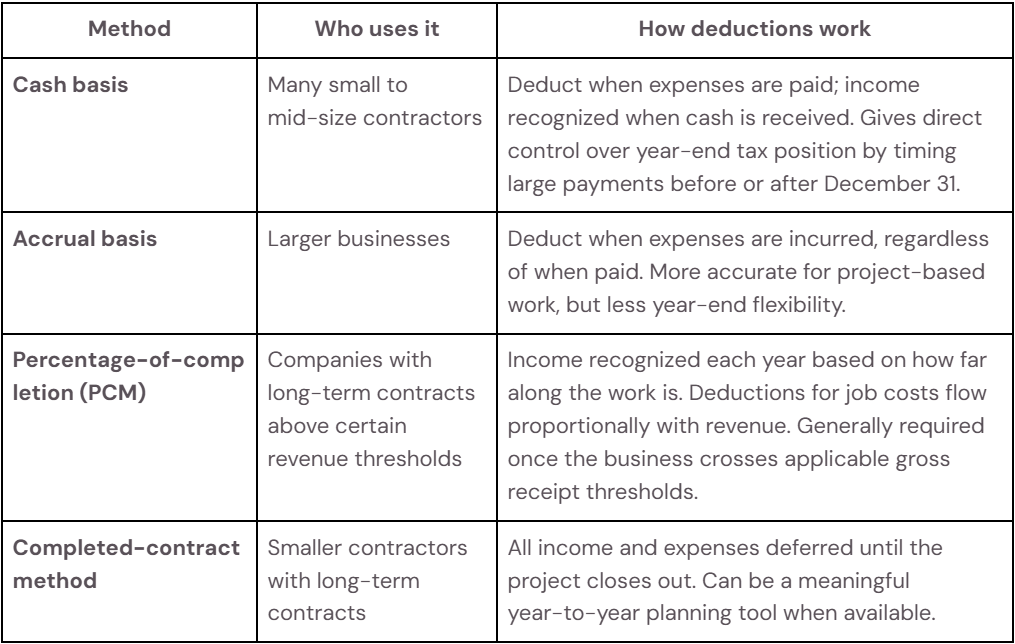
Method changes require IRS approval and can trigger a one-time income adjustment. If your current method doesn't reflect how your business actually operates, or if you've grown past a revenue threshold that changes your options, that's worth a conversation with a CPA.
Construction tax planning covers the timing of equipment purchases, entity structure, how subcontractor relationships are documented, and whether your accounting method is actually working for you.
Porte Brown's team works with general contractors, subcontractors, specialty trades, and homebuilders for taxes, deductions, and construction accounting across the Chicago area and Illinois. We understand the construction business cycle, including how cash flow timing creates year-end planning opportunities and what the common compliance blind spots are.
If you want to walk through your current deduction strategy before the end of the tax year, contact Porte Brown to learn more about how we work with construction businesses.
Construction companies can deduct most ordinary business expenses: equipment and machinery, vehicles used for business, employee wages and payroll taxes, subcontractor payments, materials, insurance premiums, job site costs, software, professional fees, marketing, and continuing education. Pass-through entities can also claim the 20% qualified business income (QBI) deduction. The 2025 tax reform restored 100% bonus depreciation and made QBI permanent, both of which have a fairly significant impact on construction businesses.
Section 179 lets you deduct the full cost of qualifying equipment in the year you place it in service, rather than depreciating it over several years. For 2025 and beyond, the deduction limit is $2.5 million, with a phaseout beginning at $4 million in total annual asset purchases. Unlike bonus depreciation, Section 179 can't push your taxable income below zero, but unused amounts carry forward. It applies to new and used equipment, vehicles, off-the-shelf software, and certain building improvements.
Both let you deduct equipment costs faster than standard depreciation schedules, but they work differently. Section 179 is elective (asset by asset), capped at $2.5 million, and can't create a loss. Bonus depreciation applies automatically (you must affirmatively elect out), has no dollar cap, and can create a loss that carries forward as a net operating loss. They can be used together, and the right combination depends on your income position and tax planning goals.
Yes. Payments to subcontractors are fully deductible as ordinary business expenses. The compliance requirement: if you pay an unincorporated individual $600 or more during the year for services, you must file Form 1099-NEC and report the payment to the IRS. Collect Form W-9 from every subcontractor before making a first payment. Worker misclassification (treating someone who functions as an employee as an independent contractor) is a separate and more serious issue that can result in back payroll taxes and penalties.
Yes. Workers' compensation premiums are fully deductible as a business expense. So are general liability, commercial auto, builder's risk, professional liability, umbrella policies, inland marine coverage for tools and equipment, and surety bond premiums. Insurance is one of the larger cost categories for construction businesses, and it's fully deductible.
With the qualified business income (QBI) deduction, eligible pass-through entities, including sole proprietorships, S corporations, partnerships, and LLCs, can deduct as much as 20% of their net business earnings from federal taxable income. Thanks to the OBBBA, this tax benefit is now permanent as of 2025. Because construction is generally not designated as a specified service trade or business (unlike fields such as law or finance), most contractors qualify without facing the service-based restrictions. However, high-income threshold phaseouts still apply, where total W-2 wages paid and unadjusted basis of qualified property come into play.
Employers can deduct health insurance premiums paid for employees as a business expense. Self-employed owners (sole proprietors, partners, and S corp shareholders owning more than 2% of the company) can deduct 100% of premiums for themselves and their families as an above-the-line personal deduction, provided they weren't eligible for employer-sponsored coverage elsewhere. For S corp shareholders, premiums must be properly included in W-2 wages before being claimed as a personal deduction.
The IRS requires documentation that supports the nature, amount, and business purpose of each deduction. For equipment and large purchases: invoices, receipts, and proof of payment.
Get in touch today and find out how we can help you meet your objectives.