Construction accounting operates under different rules than standard business accounting. Projects span months or years, costs shift with change orders and weather delays, and revenue recognition depends on contract structures that don't exist in most other industries.
Trying to force construction operations into general-purpose accounting tools creates blind spots that erode margins. To protect profitability, you need a financial system built for the field.
Construction accounting focuses on project-level performance instead of broad company totals. While a typical business evaluates health by department or product line, a contractor tracks each project as an independent financial entity.
Construction financial management must also handle mechanics that rarely occur elsewhere, including work-in-progress (WIP) accounting, retainage withheld from pay applications, revenue recognized progressively across multi-year contracts, and scope changes that alter budgets and timelines mid-stream.
Standard accounting assumes predictable, short-term transactions with stable cost structures, while construction breaks from those assumptions. The differences below are what make accounting for construction more complex and why general frameworks often fall short for contractors and builders.
Construction accounting is organized around individual projects rather than departments or product lines. Each project functions as its own cost center with a unique budget, timeline, and set of financial obligations. If a general contractor runs five active jobs using shared crews and equipment, they still need isolated profitability reports for each site.
This structure means that every cost must be coded to the correct job at the point of entry. Miscoding can distort margins on two projects at once and leads to bad bids down the road.
Construction contracts often span months or years, creating challenges that standard accounting cycles don't account for. Revenue doesn't arrive in neat monthly increments, costs front-load on some projects and back-load on others, and cash flow swings depending on billing schedules, retainage terms, and customer payment habits.
Long timelines also mean financial conditions can change between contract signing and final punch-list. Accounting systems need to capture these changes as they happen rather than reconciling them after the fact.
Change orders are inevitable in construction. Clients revise scope, site conditions reveal unexpected problems, and design changes ripple through budgets and timelines. Each change order can alter the contract price, the completion date, or the cost structure.
Accounting systems need to capture these adjustments as they're approved, not after the project wraps. Unrecorded change orders create immediate phantom margins that distort project performance until reality catches up.
Most businesses recognize revenue when they deliver a product or complete a service. Construction businesses often recognize revenue over time as physical work progresses, which introduces its own set of accounting requirements.
Billing structures also vary by contract type. Some projects bill based on milestones while others bill on time and materials or against a fixed contract price. Each billing method requires a different accounting treatment, and a single company may use multiple methods across its active projects.
Several foundational concepts drive how construction companies track financial performance. Understanding how these work individually and how they interact is what separates accurate construction accounting from approximations that hide margin erosion.
Job costing is the practice of tagging every dollar spent to a specific job and cost code (labor, concrete, electrical subs, etc.). Disciplined job costing tells you the exact real-time cost of a build so you can adjust course before losing money and use historical data to bid accurately on future work.
In practice, job costing requires disciplined cost coding at every transaction. A purchase order for lumber, a timecard for a carpenter, an equipment rental invoice, and a subcontractor draw all need to be tagged to the correct job and the correct cost category within that job. Without this level of detail, project-level profitability becomes guesswork.
A WIP schedule compares actual costs incurred, revenue earned, and amounts billed across active jobs to uncover overbilling and underbilling.
Both conditions affect bonding capacity and lending decisions. Bonding companies and lenders scrutinize WIP schedules closely, so accuracy directly affects a contractor's ability to take on new work.
Project owners typically withhold 5-10% of each progress payment until the work is substantially complete or passes final inspection. This gap between earned revenue and collected cash creates significant liquidity pressure.
General contractors often match these terms by withholding retainage from subcontractor payments, meaning retainage affects both the receivable and payable sides of the ledger. This needs to be accounted for separately from standard accounts receivable so that financial statements accurately reflect the company's liquidity position.
Construction companies often recognize revenue using one of two primary methods: percentage-of-completion and completed-contract. Choosing between the two depends on the contract structure and how reliably the company can measure progress toward completion.
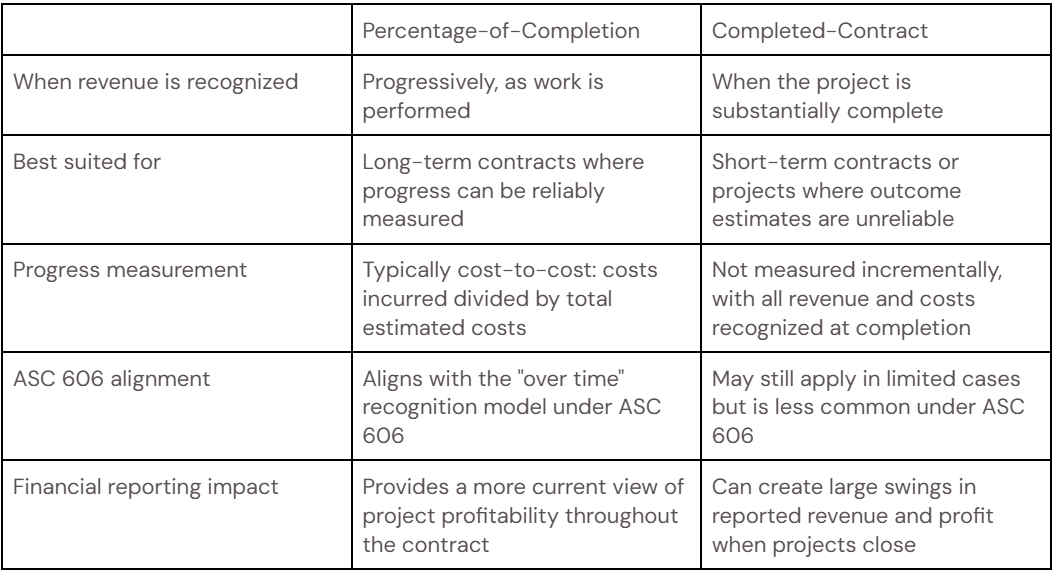
ASC 606 (Revenue from Contracts with Customers) is the current accounting standard governing revenue recognition. Under ASC 606, construction companies must evaluate whether their contracts meet the criteria for recognizing revenue over time. Most construction contracts qualify for over-time recognition, where the percentage-of-completion method remains the standard approach. However, the standard requires companies to demonstrate that they can reliably measure progress toward completion and that control of the work transfers to the customer continuously.
Billing and revenue tracking methods vary by contract type, and most construction companies use more than one across their active projects. The method needs to match the contract terms and how the company can reliably measure and document progress.
Progress billing ties invoices to specific completion milestones or percentages of work completed. The contractor submits a pay application showing work completed during the billing period, and the project owner pays based on verified progress.
This method requires field reports and verified cost data to prevent disputes with owners or lenders. Each billing cycle needs an accurate assessment of completion percentages, supported by inspection records and cost documentation.
Time and materials (T&M) billing charges based on actual labor hours and materials used, plus a negotiated markup. This method works well for projects where the scope isn't fully defined at the start, such as renovation work where conditions behind walls can't be predicted, or emergency repair projects where speed matters more than a fixed price.
T&M contracts require strict daily timecard and receipt tracking. The contractor needs to document every hour and every purchase because each one directly affects the invoice amount.
Fixed-price contracts set a single price for a defined scope of work. The contractor absorbs all cost risk, which makes real-time job costing the only way to confirm that actual costs are running below the bid.
From an accounting standpoint, the challenge is tracking whether actual costs are ahead of or behind the estimate. If costs exceed the contract price, the project loses money. Accurate job costing and regular cost-to-complete estimates are how contractors identify problems early enough to correct course.
Unit price billing charges per unit of work completed: per cubic yard of concrete poured, per linear foot of pipe installed, per square foot of flooring laid. This method is common in heavy civil work where final scope quantities fluctuate from the original bid.
The accounting treatment is straightforward on a per-unit basis, but total contract value can shift significantly if actual quantities differ from estimates. Contractors need to track unit counts carefully and reconcile them against the owner's records to avoid billing disputes.
Beyond the standard income statement, balance sheet, and cash flow statement, construction companies rely on several specialized reports to manage project-level finances and company-wide performance.
A job cost sheet tracks every cost category on a specific project: labor, materials, equipment, subcontractors, and overhead. It compares budgeted costs against actual costs and projects the cost to complete the remaining work.
Job cost sheets are the primary tool project managers and accountants use to flag budget overruns early. Weekly or biweekly review of active project job cost sheets prevents small overruns from compounding into losses that only surface at project close.
A WIP schedule compares costs incurred, revenue recognized, and billings for every active project. Its primary purpose is identifying overbilling and underbilling across the portfolio.
Bonding companies and banks use WIP schedules to evaluate lending limits and balance sheet health. Inaccurate WIP data can directly limit a contractor's bonding capacity and ability to take on new work.
A CIP report tracks accumulated costs of projects still underway and reports them as a long-term asset on the balance sheet. Where a WIP schedule focuses on the relationship between costs, revenue, and billings, a CIP report focuses on the asset value of work that hasn't yet been completed and transferred.
CIP reporting is especially relevant for owner-developers building properties for their own portfolio rather than a third-party client. The distinction affects how and when costs move from the balance sheet to the income statement.
The difference between well-managed construction finances and chronic margin erosion usually comes down to discipline in a handful of recurring practices.
For construction businesses that need support building or improving these processes, Porte Brown's accounting services team works directly with contractors and builders to implement systems that scale with their operations.
The errors that cause the most financial damage in construction tend to be systemic rather than one-time events. They build gradually, project by project, until the cumulative impact shows up in cash flow problems, inaccurate bids, or bonding issues.
Generic accounting advice leaves money on the table. Porte Brown's specialized construction team helps contractors implement job costing frameworks, run accurate WIP schedules, comply with ASC 606 revenue standards, and build tax strategies tailored for commercial, residential, and civil builders.
Whether you need to overhaul an existing system or strengthen what you already have in place, our team works with you to build a financial foundation that scales alongside your operations.
Contact Porte Brown today to discuss how we can support your construction accounting needs.
Most contractors use accrual accounting combined with project-level job costing. Revenue is typically recognized over time via the percentage-of-completion method to satisfy ASC 606 rules. The specific billing method (progress billing, T&M, lump-sum, or unit price) depends on the contract type.
Overbilling means you've billed more than the revenue earned based on physical completion, which appears as a liability. Underbilling means you've completed and recognized revenue on work you haven't billed yet, which shows up as an asset. Both are tracked through WIP schedules and affect financial reporting accuracy.
ASC 606 requires contractors to prove they have a reliable method for measuring project progress (usually cost-to-cost) and that control of the work transfers to the customer continuously over time. The standard largely formalized the percentage-of-completion approach that many contractors were already using, but it introduced more specific documentation and disclosure requirements.
A construction accountant handles financial tracking specific to construction projects, including job costing, WIP reporting, revenue recognition, retainage tracking, and progress billing. They also work with project managers to monitor budgets and produce reports for lenders and bonding companies.
Costs are coded to the specific projects and cost categories they belong to. Labor hours go to the job where work was performed, materials to the project they're intended for, and subcontractor invoices to the relevant job. Equipment costs are either charged directly or allocated using internal rental rates based on usage.
Get in touch today and find out how we can help you meet your objectives.